
The Letter That Started the Atomic Age
On August 2, 1939, Albert Einstein signed a two-page warning to Roosevelt. Six years later, Hiroshima.

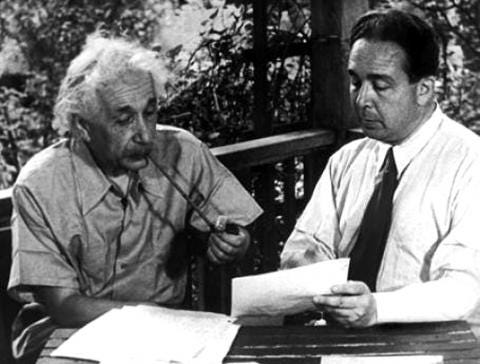
In late July 1939, a Hungarian-Jewish physicist named Leo Szilard drove out from Manhattan to a small rented cottage on Nassau Point, on the eastern end of Long Island. He did not know how to drive. His colleague Eugene Wigner, another Hungarian émigré at Princeton, was at the wheel. They were looking for Albert Einstein, who was on his summer vacation there, sailing his little boat and playing his violin. When they finally found the cottage, Einstein came to the porch in a white cotton shirt and old trousers, unshaven, and offered them lemonade.
Szilard had come to explain the physics of the previous six months. In January of 1939, the news had reached America that two Germans — Otto Hahn and Fritz Strassmann in Berlin — had split the uranium atom. Szilard, who had first conceived of a nuclear chain reaction crossing a London street in 1933, understood at once what fission meant. If the splitting of one uranium nucleus released more than one neutron, and each of those neutrons could split another nucleus, you would have a chain. A very fast chain, in a very small volume, would be a bomb of an unprecedented kind. By the spring of 1939, Enrico Fermi had confirmed at Columbia that fission did indeed release multiple neutrons. The chain was real. It only remained to build it.
Szilard's private terror was that the Germans, who had discovered fission and who still had the finest physics faculties in the world, were already trying. Occupied Czechoslovakia had among the richest uranium mines in Europe, at Joachimsthal. Berlin had cut off their exports the week the German army marched in. The pattern was clear enough to any physicist who was paying attention.
"I Hadn't Thought of That"
Einstein had not been paying attention. He had not worked on nuclear physics in years, and the possibility that the chain reaction could be weaponized had not occurred to him. When Szilard laid out the situation on the porch that afternoon, Einstein listened, thought, and then said in German, quietly: "Daran habe ich gar nicht gedacht" — "I hadn't thought of that."
He was seventy-one years old, the most famous scientist in the world, and a lifelong pacifist. But he was also a German Jew who had watched Berlin from a distance for six years now. He agreed at once that the American government had to be told.
The first draft they wrote on the porch that day did not go out. Szilard came back a second time, this trip on the morning of August 2 itself, driven by Edward Teller — another Hungarian at George Washington University — in Teller's 1935 Plymouth. They brought a new draft. Einstein signed it on the porch.
The Letter
It was two pages. It began plainly: "Sir: Some recent work by E. Fermi and L. Szilard, which has been communicated to me in manuscript, leads me to expect that the element uranium may be turned into a new and important source of energy in the immediate future." It described, in careful and measured language, the possibility of "a nuclear chain reaction in a large mass of uranium" and the resulting possibility of "extremely powerful bombs of a new type." It noted that a single such bomb, carried by boat and detonated in a port, "might very well destroy the whole port, together with some of the surrounding territory." It observed that Germany had suddenly stopped the export of uranium from the mines it now controlled in Czechoslovakia. It recommended three actions: informal liaison between the government and the American physicists, an acceleration of experimental work, and the securing of a supply of uranium ore — likely from the Belgian Congo, where the richest deposits then known were held by the Union Minière du Haut-Katanga.
It was signed A. Einstein, and dated August 2, 1939.
October 11
The letter did not reach President Franklin Delano Roosevelt until October 11. Alexander Sachs — an economist and informal Roosevelt adviser to whom Szilard had entrusted the letter — waited weeks for an appointment. Between the letter's signing and its delivery, Germany invaded Poland and the Second World War began.
At the October 11 meeting Sachs presented the letter along with a covering memorandum of his own explaining the physics for a non-scientist. Roosevelt was polite but not persuaded. Sachs left the meeting worried the President had not grasped what he was being told. He asked to come back the next morning at breakfast. Roosevelt agreed.
At that breakfast on October 12, Sachs told FDR a story instead of reading the letter again. Napoleon, in 1804, had been offered by the American inventor Robert Fulton the design for a steamship that could invade England regardless of the wind. Napoleon had scoffed and refused. He had then lost the war at sea to a British Navy still under sail. The moral, Sachs told Roosevelt, was that great powers ignore new technologies at their peril.
Roosevelt listened for the whole story in silence. When it was over, he was quiet for a long moment. Then he said, "Alex, what you are after is to see that the Nazis don't blow us up." He called in his personal secretary, General Edwin "Pa" Watson, and said the sentence that opened the atomic age: "Pa — this requires action."
Within nine days FDR had chartered the Advisory Committee on Uranium under Lyman Briggs of the National Bureau of Standards. The committee met for the first time on October 21, 1939. It was given a first appropriation of six thousand dollars for graphite and uranium oxide.
What Six Thousand Dollars Became
The Uranium Committee moved slowly at first. It became the S-1 Committee in June of 1941. In August of 1942 it became the Manhattan Engineer District under Brigadier General Leslie Groves. Over the next three years, the American government spent approximately two billion 1945 dollars — the equivalent of roughly thirty-five billion today — building the largest single scientific and industrial project in human history. It employed, at its peak, one hundred and thirty thousand people at Oak Ridge, Hanford, Los Alamos, and dozens of smaller sites. It built the isotope-separation cascades, the plutonium production reactors, and the physics of the bomb itself.
At 5:29 A.M. on July 16, 1945, in the New Mexico desert at a site called Trinity, the first of them was tested. Robert Oppenheimer thought of a line from the Bhagavad Gita.
Twenty-one days later, at 8:15 A.M. on August 6, 1945, a modified B-29 called Enola Gay dropped a uranium-235 bomb, code-named Little Boy, on the Japanese city of Hiroshima. Three days after that, a plutonium implosion device, code-named Fat Man, was dropped on Nagasaki. The Japanese Empire surrendered on August 15. The Second World War was over.
Einstein learned of Hiroshima on the radio at his home in Princeton, New Jersey. He listened for a long time in silence. Then he said, in German: "Oh, weh." Oh, woe.
He would spend most of the last decade of his life campaigning for international control of atomic weapons. In a 1954 conversation with the American chemist Linus Pauling, he is reported to have said that his one great mistake in life was signing the letter to Roosevelt in 1939 — that he ought to have known, even then, that the Germans were nowhere near succeeding, and that his signature had helped set the whole thing in motion.
He was, on that last point, probably too hard on himself. Szilard would have written the letter with or without him. Someone would eventually have signed it. But it was Einstein's name on the page that reached the President's desk and got read aloud, and it was Einstein's name that FDR trusted enough to say the words that started the machine.
Below the paywall: the Hungarian physicist who conceived the chain reaction crossing a London street in 1933, drove to Long Island to get Einstein's signature, and then spent the rest of his life trying to un-do what he had started.
