
The Attack That Never Happened
On August 4, 1964, a US destroyer reported a phantom torpedo attack. LBJ got his war three days later.

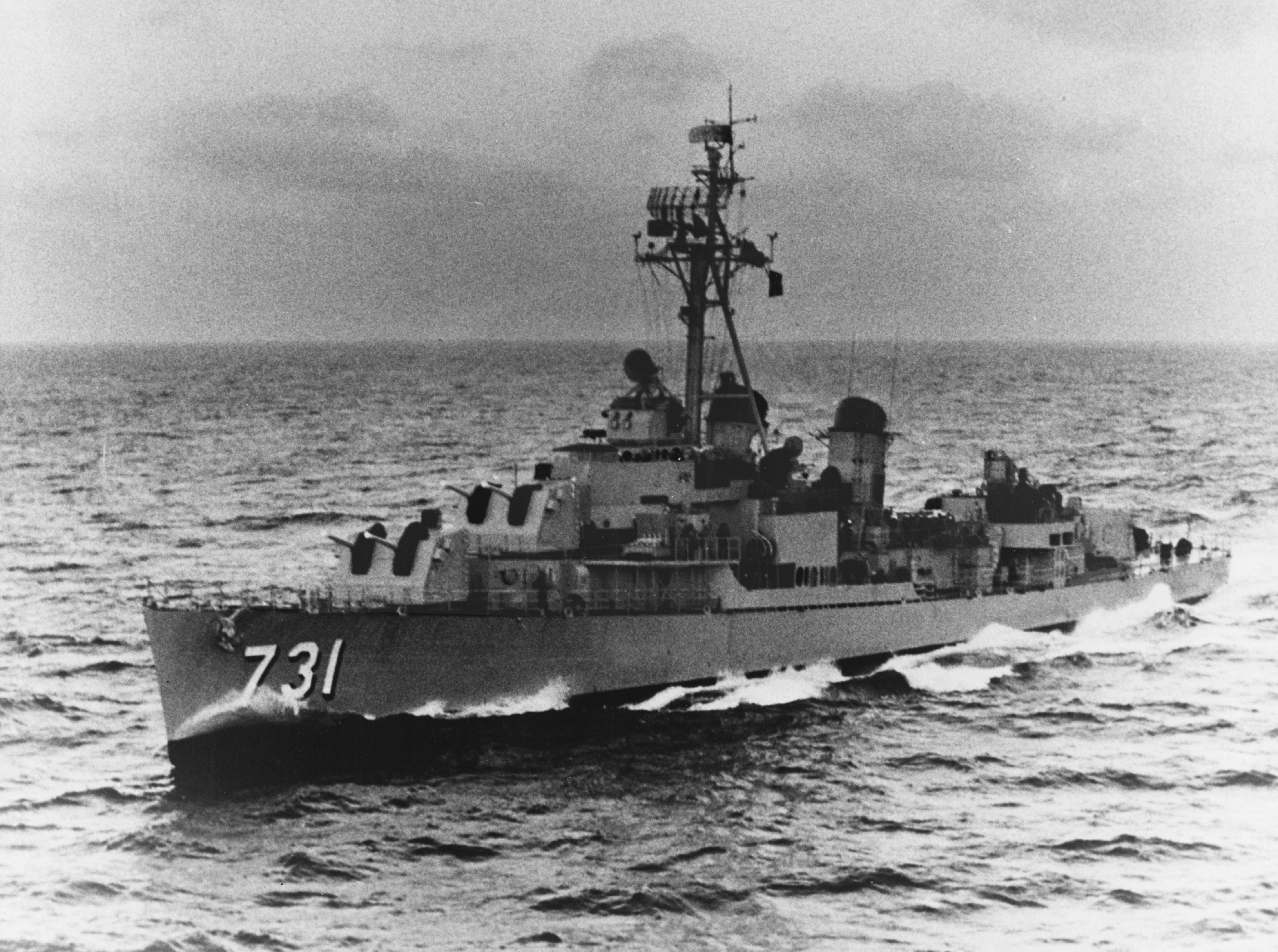
The night was black. The Gulf of Tonkin was a wall of thunderstorms, no moon, seas high enough that the destroyers' bows were burying themselves in the swells. On the bridge of USS Maddox, sixty-five miles off the coast of North Vietnam, Captain John J. Herrick — the commander of Destroyer Division 192, embarked aboard the Maddox for the patrol — watched his sonarmen call out contacts on scopes that had been distorted for hours by the weather. Commander Herbert L. Ogier, the Maddox's own captain, had the deck. It was the evening of August 4, 1964.
At 9:39 P.M. local time, one of the sonarmen reported a torpedo in the water. Then another. Then twenty-two more. Herrick's ships — the Maddox and the destroyer USS Turner Joy, ordered to accompany her after the previous incident — went to general quarters, opened fire with their five-inch guns on radar contacts they could not see, and radioed Honolulu that they were under a coordinated night attack by North Vietnamese torpedo boats.
There were no torpedo boats.
The Real Attack, Two Days Earlier
The August 4 encounter was the second Gulf of Tonkin incident. There had been a first, on August 2, that had actually happened. On that afternoon three North Vietnamese P-4 motor torpedo boats had come out of the coast and attacked the Maddox in broad daylight roughly twenty-eight miles offshore. The Maddox had fired warning shots, then engaged. F-8 Crusaders from the carrier Ticonderoga had raced in and strafed the boats. One P-4 was heavily damaged; the two others withdrew. The Maddox took a single 14.5mm bullet in the aft superstructure. No American was killed. The attack itself was clear-cut — real boats, real torpedoes, real cannon fire.
The Johnson administration decided not to retaliate for the August 2 attack. It ordered the Maddox to continue her patrol, brought up the Turner Joy, and told the ships to stay well out at sea. This was the assignment on August 4.
The Second Night
For three hours starting around 8 P.M. on August 4, the Maddox and Turner Joy zigged through the storms firing at radar and sonar returns their own crews were beginning to doubt. Herrick himself was beginning to doubt. By 1:27 A.M. local time on August 5, the fight — if there had been one — was over. Herrick sat down and drafted an urgent cable to his fleet commander in Honolulu, which was forwarded to Washington. It read, in part:
"Review of action makes many reported contacts and torpedoes fired appear doubtful. Freak weather effects on radar and overeager sonarmen may have accounted for many reports. No actual visual sightings by MADDOX. Suggest complete evaluation before any further action taken."
The cable landed on Secretary of Defense Robert McNamara's desk in Washington in the small hours of the American morning. McNamara passed it on. He also, however, chose to act on the earlier reports of the attack. So did President Lyndon Johnson.
At 11:36 P.M. Eastern time on August 4 — before Herrick's doubting cable had been fully evaluated — Johnson went on national television and told the country that a second, unprovoked attack had taken place on American vessels in international waters. He announced retaliatory airstrikes already underway against North Vietnamese naval bases. "We still seek no wider war," he said.
The next day, Operation Pierce Arrow — the first American airstrikes of the Vietnam War against North Vietnam — hit four torpedo boat bases and an oil depot at Vinh. Two US aircraft were lost. One pilot was killed. The other, Lieutenant Everett Alvarez Jr., ejected and became the first American to be captured as a POW in North Vietnam. He would spend the next eight and a half years at the Hanoi Hilton.
Congress
On August 7, 1964, three days after the phantom attack, Congress passed the Southeast Asia (Gulf of Tonkin) Resolution. The vote in the House was 416-0. The vote in the Senate was 88-2. The two dissenters were Senator Wayne Morse of Oregon and Senator Ernest Gruening of Alaska. Morse, on the floor of the Senate, said he believed the resolution was unconstitutional and predicted it would be "a source of much sorrow to us for a long time to come."
The resolution empowered the President to "take all necessary measures to repel any armed attack against the forces of the United States and to prevent further aggression" in Southeast Asia. Johnson signed it on August 10. He would carry a folded copy of it in his suit-jacket pocket for the next four years as the legal authority for every American military decision in Vietnam. Under its terms, US troop strength went from 23,000 in 1964 to over 500,000 by 1968. Fifty-eight thousand Americans and more than a million Vietnamese would eventually die under its shadow.
"Shooting at Whales"
The doubts began to leak almost immediately. James Stockdale — later a Vietnam War POW, later still Ross Perot's running mate in 1992 — had been flying an F-8 Crusader over the Maddox and Turner Joy on the night of August 4. He had a clear visual view of the ships and the water for hours. He testified in 1968, and wrote in his memoirs, that there were no boats in the water. "I had the best seat in the house to watch that event," Stockdale said, "and our destroyers were just shooting at phantom targets. There were no PT boats there."
Johnson himself, privately, in the White House the following year, is reported to have told an aide: "For all I know, our Navy was shooting at whales out there."
In late 2005, the National Security Agency finally declassified a 2001 internal study by cryptographic historian Robert J. Hanyok. Hanyok's report, based on the original 1964 signals intercepts, concluded flatly that no attack had occurred on August 4, 1964, and that NSA officials at the time had known the intercepts contradicted the reported attack — and had suppressed the exculpatory intelligence rather than let it disturb the Administration's decision to escalate.
Senator J. William Fulbright, who as chairman of the Foreign Relations Committee had personally shepherded the resolution through the Senate, chaired hearings in 1968 that exposed the deception. He said afterward that he had been misled by McNamara and that shepherding the resolution had been the worst act of his political career. Congress repealed it in January 1971. By then more than 45,000 Americans had died in the war it had authorized.
The Maddox remained in service. She was decommissioned in 1969 and eventually sold to the Republic of China Navy as the ROCS Po Yang. She was scrapped in 1985.
The war she had started did not really end until Saigon fell in April of 1975 — eleven years after a summer night in a thunderstorm when a sonarman had called out a torpedo that was not there.
Below the paywall: Captain Herrick's own cable that night casting doubt on the entire second attack — read by McNamara in Washington within the hour, and set aside because Washington had already decided to escalate.
